

Introduction
Building successful digital products requires more than visual design. Instead, teams must follow a structured UX strategy framework that combines research, usability evaluation, and continuous improvement.
Many startups focus on adding features quickly. However, without a clear UX strategy framework, products often develop usability gaps. As a result, users face confusion, poor onboarding, and inconsistent navigation.
Therefore, a structured UX strategy framework helps teams align product decisions with user needs and business goals. It also ensures that usability improvements are proactive rather than reactive.
In my experience working on product design projects, UX issues often do not come from poor design skills but from the absence of a clear strategy. Without direction, even good design decisions fail to connect.
Many teams focus on improving individual screens, but without a clear UX strategy, even well-designed interfaces fail to create a cohesive product experience.
In my experience, most UX problems are not due to poor design execution but due to lack of clear strategic direction.
Many teams focus on improving individual screens, but without a clear UX strategy, even well-designed interfaces fail to create a cohesive product experience.
From My Experience
In an e-commerce project, users were dropping off during the product discovery stage. Although the platform had a wide range of products, users struggled to navigate categories and find relevant items.
The issue was not the design quality but the lack of a clear UX strategy. Different sections of the platform were designed independently, leading to inconsistent navigation and user flows.
We introduced a structured UX strategy by aligning user goals with business objectives. By reorganizing product categories, improving filtering, and streamlining navigation, users were able to find products more efficiently.
This resulted in improved engagement and a noticeable increase in product exploration and conversions.
UX Strategy Framework I Use
- User Goals Identification
- Business Objective Mapping
- User Journey Design
- Interaction Optimization
- Continuous Improvement
I’ve noticed that teams often jump into design without aligning on user goals, which leads to inconsistent product experiences.
How UX Strategy Improves Decision-Making
A structured UX strategy helps teams decide what to build and what to avoid. Instead of adding features based on assumptions, decisions are guided by user needs and business priorities.
Why UX Strategy Matters for Product Success
User experience directly affects how users interact with digital products. When interfaces are unclear, users quickly lose interest.
Therefore, a strong UX strategy framework helps teams improve usability and engagement. It also ensures that design decisions align with business goals.
- Improve onboarding clarity
- Increase feature adoption
- Reduce support requests
- Improve retention
Without a structured approach, UX decisions often become reactive. As a result, deeper usability issues remain unresolved.
Core Components of a UX Strategy Framework
An effective UX strategy framework consists of several interconnected elements. Each component contributes to improving usability, performance, and scalability.
The most important components include: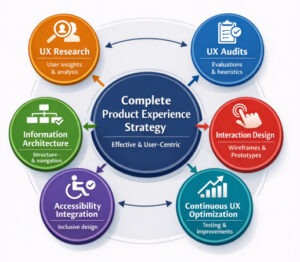
UX Research | UX Audits | Information Architecture | Interaction Design | Accessibility Integration | Continuous UX Optimization
When these components work together, they form a complete product experience strategy.
UX Research: Understanding User Behavior
UX research forms the foundation of every UX strategy. Without research insights, product teams risk designing experiences that do not reflect real user needs.
Research methods help teams understand how users interact with products and where usability problems occur.
Common UX research methods include:
- User interviews
- Usability testing
- Behavioral analytics
- Surveys and feedback analysis
These techniques help teams identify friction points, feature usage patterns, and user expectations.
A deeper exploration of these research techniques can be found in UX Research Methods for Product Teams, which explains how research insights influence product design decisions.
When UX research is integrated early in the product development process, teams can design experiences that align with real user behavior.
UX Audits: Identifying Usability Gaps
UX audits are structured evaluations used to identify usability problems across a digital product.
Rather than redesigning interfaces from scratch, UX audits allow teams to detect targeted improvement opportunities.
A typical UX audit evaluates:
- Navigation clarity
- Information architecture
- User flows
- Accessibility compliance
- Performance issues
For startups and SaaS platforms, regular usability audits prevent small problems from becoming large structural issues.
Teams often follow frameworks similar to the UX Audit Framework for Digital Products to systematically evaluate interface performance.
UX audits are particularly valuable when products experience declining user engagement or increasing support requests.
Information Architecture and Product Clarity
Information architecture defines how content and features are organized within a digital product.
Poor information architecture is one of the most common usability issues in digital platforms. When features are poorly structured, users struggle to locate the tools they need.
Strong information architecture focuses on:
- Logical feature grouping
- Clear navigation hierarchy
- Predictable workflows
- Reduced cognitive load
Enterprise platforms often require role-based interface structures. For example, dashboards for administrators may differ significantly from those used by operational teams.
A practical implementation of these concepts is explained in B2B Portal UX Strategy, which explores how complex systems can maintain usability through structured interface design.
Interaction Design and UI Animation
Interaction design determines how users interact with interface elements such as buttons, forms, and navigation components.
UI animation plays an important role in improving user feedback and guiding attention during interactions.
When implemented correctly, animation enhances usability by:
- Providing system feedback
- Guiding user attention
- Clarifying transitions between interface states
However, excessive motion or decorative animations can reduce usability.
Design teams often follow principles described in UI Animation Principles for Modern Interfaces, which explains how motion design supports interaction clarity.
Well-designed interaction systems improve both usability and user satisfaction.
Visual Usability and Interface Clarity
Visual design influences how users interpret and navigate interfaces.
Effective visual usability design focuses on clarity rather than decoration. Interfaces should guide users through tasks without overwhelming them with visual complexity.
Key visual usability principles include:
- Typography hierarchy
- Color contrast
- Consistent spacing
- Clear call-to-action visibility
Many usability issues occur when visual design prioritizes aesthetics instead of functional clarity.
A deeper discussion of these principles can be found in Visual Design and Usability Principles for Digital Products.
By prioritizing clarity and consistency, teams can significantly improve product usability.
Accessibility as a Strategic UX Component
Accessibility is often treated as a compliance requirement. However, accessibility improvements frequently enhance usability for all users.
Accessible design ensures that digital products remain usable for people with diverse abilities and technical environments.
Accessibility improvements often include:
- Proper color contrast
- Keyboard navigation support
- Screen reader compatibility
- Clear error messaging
Organizations that integrate accessibility early in product development often benefit from improved user engagement and broader audience reach.
The relationship between accessibility and business outcomes is explored in Accessibility and Business ROI.
UX Process Integration in Product Development
UX strategy becomes most effective when it is integrated directly into the product development lifecycle.
A structured UX process ensures that research insights, usability evaluation, and design improvements influence product decisions.
The typical UX workflow includes:

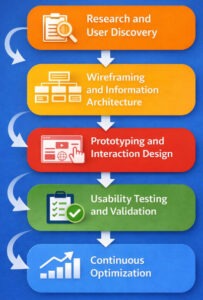
Research and user discovery | Wireframing and information architecture | Prototyping and interaction design | Usability testing and validation | Continuous optimization
A detailed overview of this workflow is explained in UX Process Breakdown for SaaS Products, which illustrates how design teams move from research insights to scalable product solutions.
By following a structured UX process, organizations reduce design debt and improve collaboration between designers, developers, and product managers.
Continuous UX Optimization
UX strategy is not a one-time effort. Successful products continuously evolve based on user feedback and behavioral insights.
Continuous UX optimization includes:
- Monitoring user analytics
- Conducting usability testing
- Running A/B experiments
- Reviewing user feedback
This iterative approach ensures that product improvements remain aligned with changing user needs.
Products that neglect ongoing usability evaluation often experience declining engagement over time.
Connecting UX Strategy with Business Goals
UX strategy should always align with broader business objectives.
Design improvements should influence measurable outcomes such as:
- Conversion rate
- retention rate
- Onboarding completion
- Feature adoption
When UX improvements are connected to business metrics, organizations can clearly measure the impact of design decisions.
UX strategy therefore becomes a critical component of product growth rather than a purely visual discipline.
Frequently Asked Questions
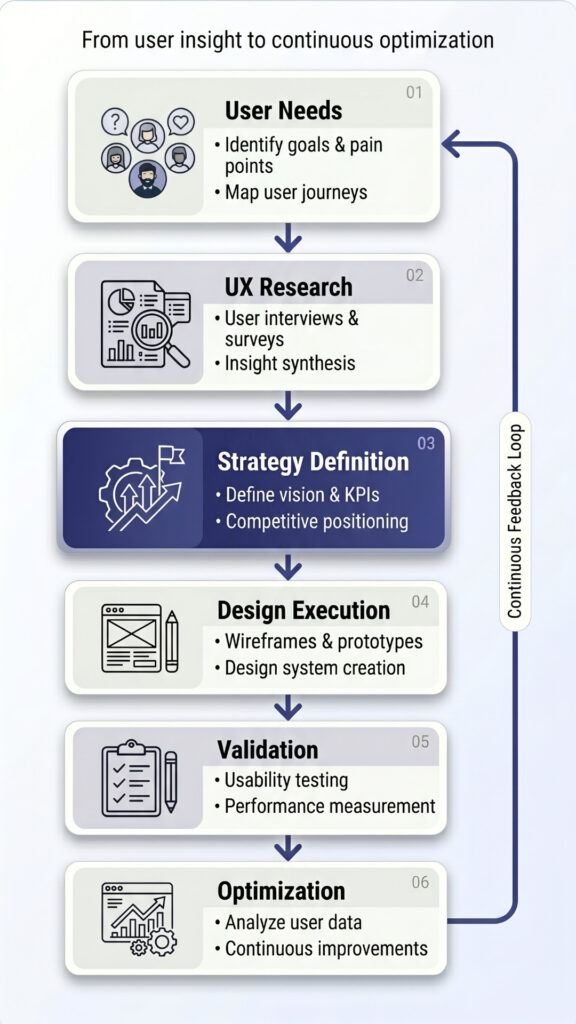
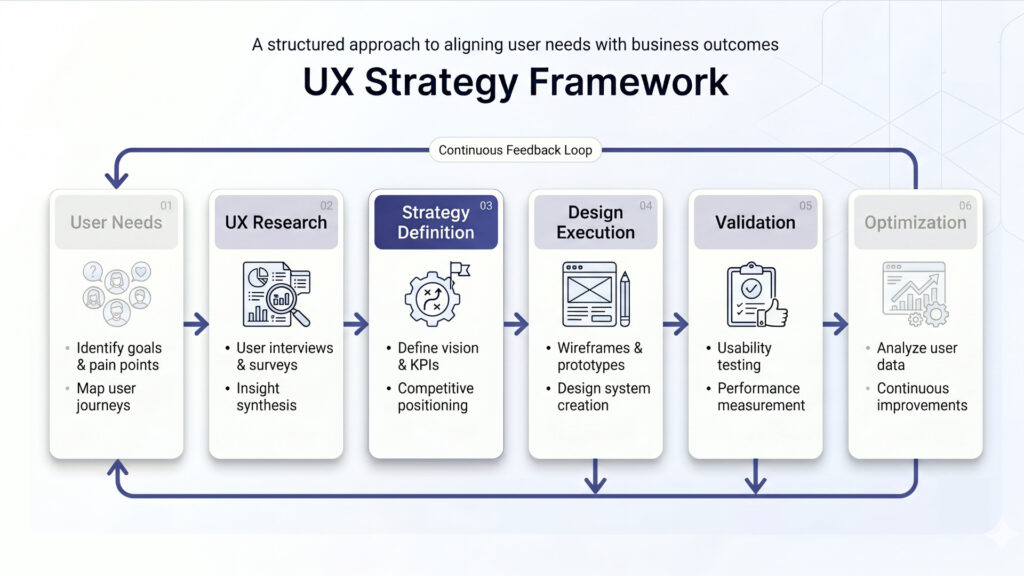
What is a UX strategy framework?
A UX strategy framework is a structured approach used to align design decisions with user needs and business goals.
Why is UX strategy important?
UX strategy improves usability, increases engagement, and helps teams build scalable digital products.
How often should UX evaluations occur?
Most digital products benefit from usability reviews every few months. However, rapidly growing platforms may require more frequent UX analysis.
Real UX Problems and How Strategy Solves Them
- Problem: Features designed in isolation leading to inconsistent user experience
- Solution: A structured UX strategy that aligns all features with user journeys
- Problem: Users dropping off due to unclear navigation paths
- Solution: Mapping user flows and simplifying navigation structure
- Problem: Teams focusing on UI instead of usability
- Solution: Defining UX principles before design execution
Key Insight
A UX strategy is not about designing better screens; it is about designing better decisions. When teams align user needs with business goals, the entire product experience becomes more consistent, scalable, and effective.
Final Thoughts
A successful digital product requires more than design tools and interface aesthetics. It requires a clear UX strategy framework that connects research, usability evaluation, design systems, and product optimization.
By integrating UX research, accessibility practices, and structured workflows, organizations can build digital products that remain usable, scalable, and aligned with business goals.
Ultimately, UX strategy transforms design from a visual activity into a strategic product discipline.
Most UX issues are not caused by lack of effort but by lack of clarity in product direction.